
From Beijing to Washington: Xi's Visit Puts Students Back at the Center of US-China Ties
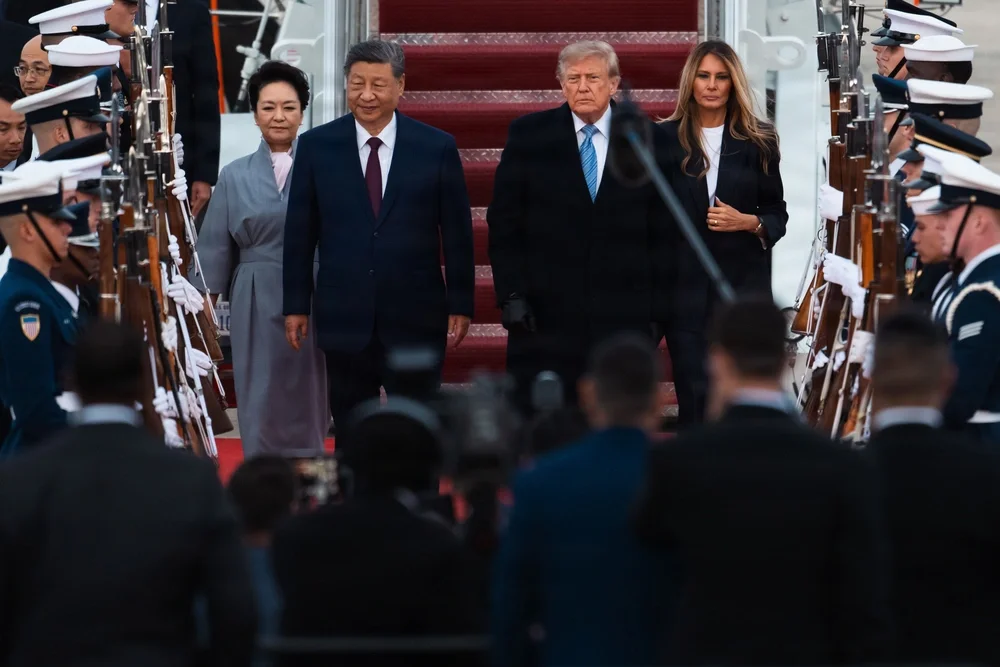
Photo by Senior Airman Daniel Walderbach, via DVIDS.
Xi Jinping's September 23-25 state visit to Washington picked up where May's Beijing summit left off. President Trump greeted him planeside at Joint Base Andrews, hosted a state dinner at the White House, and signed on to an eight-point consensus built around a "constructive strategic and stable relationship," which we predicted in our June post on the U.S.-China détente.
Trade, AI, and Taiwan dominated the headlines, but the visit's most concrete deliverable for U.S. universities was about young people. Xi's pledge to bring 100,000 young Americans to China is a signal from the very top, broadcast to Chinese families, that educational ties with the U.S. are welcome again. Paired with a calmer U.S. policy climate and Chinese demand that has held up better than other markets, it gives American institutions their best opening in years to win back Chinese students, and those who move this recruitment cycle stand to gain the most.
100,000 Young Americans, and a Letter to Harvard and Central Michigan
Standing at the White House on September 24, Xi announced "an invitation for 100,000 young Americans to visit China through student exchanges in the coming five years." It doubles the 50,000-student initiative he launched in 2023, a goal Chinese officials say was met in May 2026, two and a half years ahead of schedule. "The hope of the China-US relationship lies in our people," Xi said, "and its future lies with the young."
The announcement was carefully staged. Days earlier, on September 21, Xi personally replied to a letter from nearly 100 students at 10 U.S. universities, including Harvard and Central Michigan University, who had joined the "Future Makers 2026" China-U.S. youth tour. Xi called on them to become "envoys of friendship bridging the Pacific Ocean," and Xinhua, CGTN, and China Daily gave the exchange prominent coverage. "When we sent the letter, it honestly felt like a shot in the dark," one Central Michigan senior told Xinhua.
These programs send Americans to China, yet they matter a great deal for US university recruiters. As we noted in June, Chinese parents read official media closely for cues about which countries are safe and welcoming. When state outlets spend a week celebrating American campuses, American students, and the value of studying across the Pacific, the message to a family in Chengdu or Hangzhou is unmistakable: educational ties with the U.S. are officially back in favor.
The Reaction: A Boost for Exchange, With Room to Grow
Advocates of engagement were quick to welcome the offer. "Imagine 100,000 Americans who have spent substantial time in China becoming teachers, scientists, journalists, diplomats, investors, lawyers, technology executives and political leaders," Denis Simon of the Quincy Institute told China Daily.
In a Council on Foreign Relations piece published on the eve of the visit, Rosie Levine of the U.S.-China Education Trust and CFR's Rush Doshi urged both leaders to make named exchange programs formal summit deliverables. Their numbers show where the real work lies. Xi's 100,000 target is built largely on short-term exchanges and study tours, the same formats that let China hit its first 50,000 goal early. Long-term study is another matter: the number of American students in China has fallen from about 15,000 a decade ago to roughly 2,000 today, and flagship programs such as Fulbright China have been suspended since 2020. As Levine and Doshi put it, "A United States that no longer trains people who can read Chinese primary sources, sit in Chinese classrooms, or track policy implementation on the ground is hardly more secure."
A Calmer Policy Climate
The summit also caps a year of steadier U.S. policy toward Chinese students. In May 2025, Secretary of State Marco Rubio announced that the U.S. would "aggressively revoke" visas for Chinese students, rattling families across China. By late August 2025, President Trump had reversed course, saying the U.S. would allow 600,000 Chinese students and calling it "very insulting to say students can't come here." Since then, the administration has largely avoided measures aimed at Chinese students specifically.
The broader restrictions that did emerge have run into the courts. On September 14, a federal judge in Massachusetts blocked a Homeland Security rule that would have capped international student stays at four years and tightened visas for foreign journalists, writing that the government's national security rationale "borders on the absurd."
American public opinion is moving in the same direction. A Pew survey conducted the week before Xi's arrival found that the share of Americans with negative views of China has fallen from 68% in 2021 to 54%, and a Chicago Council poll found 57% of Americans favor engagement with China over containment. For Chinese parents weighing whether their child will be welcome on an American campus, that shift matters.
Why the Timing Matters
The summit arrives at a moment when positive signals carry extra weight. International enrollment in the U.S. is down this year, with NAFSA projecting roughly 111,000 fewer international students on campus this fall. Recruiters are looking for an inflection point, and a week of warm headlines in Beijing and Washington could help provide one.
China has also proven more resilient than other markets. Indian students have been shaken by tighter visa rules and uncertainty over OPT, and Indian F-1 issuances fell 69% in the 2025 peak season while Chinese issuances partially rebounded, returning China to the top spot for new F-1 recipients. In an IIE survey of 585 U.S. institutions this summer, 65% reported stable or rising applications from China, compared with just 39% for India. Chinese families who still choose the U.S. are a risk-tolerant group to begin with. They stuck with American campuses through years of alarming pandemic-era coverage, even as Singapore, Hong Kong, and the UK offered options that felt closer, cheaper, or safer.
Headlines claiming Chinese students have stopped going abroad miss the mark. Most rely on Ministry of Education figures that only capture students who later seek official verification of their foreign credentials, a count that also happens to support the Ministry's push for TNE at home. Sunrise's own tracking of immigration data from the top 14 destination countries for Chinese students tells a different story: outbound mobility from China rose 6% year on year. The demand is there, and a friendlier political climate gives U.S. institutions a better shot at capturing more of it.
Another Signal: Beijing's Appetite for Partnership
The exchange pledge fits a broader pattern of Beijing actively seeking academic cooperation. China's Ministry of Education approved a record 285 new joint institutes and programs in 2025, bringing the total to 1,589 active transnational education (TNE) partnerships, and has set a goal of expanding TNE enrollment from roughly 800,000 students to 8 million. The December 2025 tranche alone included eight new partnerships with U.S. institutions.
For U.S. universities, the lesson is that China still wants to work with American higher education. The most direct way to benefit from that goodwill remains recruiting Chinese students to your own campus.
What This Means for Your China Recruitment
The summit hands U.S. institutions a rare asset: official Chinese endorsement of American campuses as places worth connecting with. Here is how to put it to work this cycle.
Echo the narrative in your own channels: Chinese families are hearing that U.S.-China educational ties are welcome. Reinforce that message on WeChat, RedNote, and Bilibili with content that speaks directly to parents about safety, belonging, and outcomes on your campus.
Tell your reciprocity story: If your students participate in exchanges or study abroad in China, share it with Chinese audiences. Two-way engagement is precisely what Beijing is celebrating, and it signals that your institution values the relationship.
Use the calendar: Trump and Xi are set to meet again at APEC in Shenzhen in November and at the G20 in Miami in December. Positive coverage is likely to continue straight through application season, so front-load your outreach now.
Show up in person: Face-to-face recruitment tours, especially beyond Beijing and Shanghai, remain the most reliable way to turn a friendlier climate into applications and deposits.
The Window Is Open
Xi's invitation to 100,000 young Americans confirms, at the highest level and in front of the Chinese public, that people-to-people exchange with America is once again something to celebrate. Institutions that meet Chinese families with a clear, localized, and consistent message this fall will be best placed to turn that goodwill into enrollment.
From localized digital campaigns on WeChat and RedNote to in-person recruitment tours across tier 1-3 cities, Sunrise helps U.S. universities convert a friendlier climate into a stronger China pipeline. Contact us to plan your next move.